Skip to content
Vice President,

Public Service
Vice President,
Chicago Board
of Education
District 9A, from Canaryville to Auburn Gresham. Appointed August 2025, elected Vice President April 2026. This is the record.
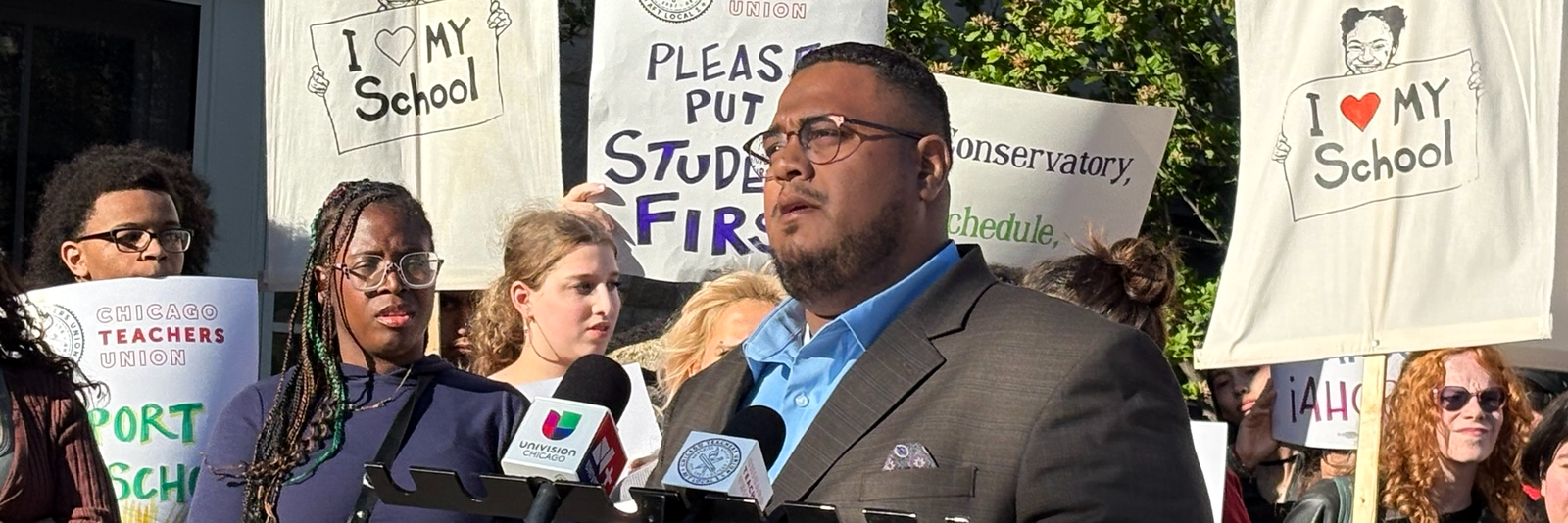
Speaking alongside students, parents, and educators
The seat
Canaryville to Auburn Gresham
The Chicago Board of Education has twenty-one members: ten elected to represent individual districts, ten appointed, and an appointed Board President. The mayor appoints eleven of them. Chicago is divided into ten districts and twenty subdistricts, and I represent subdistrict 9A as a mayoral appointee — which means I live inside the district I serve. As Vice President I preside in the President’s absence, hold continuity across the Board’s work, and am responsible for getting twenty-one people to function as a governing body. Constituents can request a one-on-one meeting through the Board officeThe record
Aug 2025 — present
JUL 2026
Advanced the ethics resolution barring board candidates from taking money from CPS vendors. Published a public letter in the Chicago Tribune against the CEO’s cuts, then voted with the majority to reject the layoffs and hold the state to $150 million. The same month, election commissioners removed my name from the November 2026 ballot after petition challenges. I continue to serve as Vice President, and this record stays public either way.
JUN 2026
Wrote progressive revenue into the Board’s official legislative agenda: a billionaire wealth tax, a digital advertising tax, and corporate tax fairness. Held charter renewals until the district produced a real oversight plan, then approved contracts paired with mid-term review that flags financial trouble early. In a contested teacher reinstatement, defended reviewing personnel discipline through a restorative lens: whether consequences are proportionate, and whether they fall evenly.
MAY 2026
Organized a coalition of five board members demanding Springfield fund public education before subsidizing a new Bears stadium, and co-led a call to back HJRCA 21, the Millionaire’s Tax. On May 29 the Board passed the resolution calling on state lawmakers to pursue progressive revenue, after a debate that began on the 13th.
APR 2026
Elected Vice President of the Board, 9–7, succeeding Olga Bautista.
MAR 2026
Voted 18–1 with the Board to name Dr. Macquline King permanent Superintendent/CEO, closing a year-long national search. Pushed to expand Sustainable Community Schools, adding holistic family resources and after-school programming.
NOV 2025
Voted to keep ChiArts open, and to allocate $1.4 million so EPIC Academy could finish the school year — with a requirement that the district offer its students seats at a district-run school and its qualified staff jobs at receiving schools.
2025–26
Backed the Black Student Success Plan committee, which the federal government later moved to investigate.
AUG 2025
Sworn in on August 28 to fill the District 9A vacancy. Voted on the district’s spending plan the same day, and approved the CPAA interim agreement — the first enforceable contract for CPS principals and assistant principals in the district’s history.
How I govern
Five commitments I can be held to.What I stand for
Illinois meeting its own funding obligation to Chicago’s children.
Resources directed by student need, not by enrollment count.
Sustainable Community Schools: neighborhood schools as full-service hubs.
A Millionaire’s Tax and corporate tax fairness instead of property-tax dependence.
Investment in low-income Black and Latino neighborhoods.
A united board that can actually win something in Springfield.
Elections free of money from the district’s own vendors.
What I stand against
Layoffs and furloughs presented as the only option.
Cutting counselors, coaches, and bilingual coordinators to close a gap the state created.
Stripping down neighborhood schools.
A funding model that rewards property wealth.
Board factions that trade student outcomes for position.
Five commitments
Standards I can be held to, not slogans.
01 · Access
A CPS diploma should open every door, not just the nearest one.
Students are tracked early, advised thinly, and left to navigate transfer and financial aid alone. Every graduate deserves a real path — a university, a credential that pays, or City Colleges without losing years to remediation.
02 · Stewardship
A budget is a moral document before it is an accounting one.
Every line item is a child. Fiscal discipline and equity are not opposed — sloppy stewardship is precisely what strands the schools with the least. The proof is in the budget stand below.
03 · Revenue
Stop asking working families to fund what wealth refuses to.
A deficit is only a limit if you accept the revenue side as fixed. HJRCA 21, a billionaire wealth tax, a digital advertising tax — the point is to decouple a child’s education from the property values around them.
04 · Evidence
Data collection has to be intentional and precise.
I teach research design. Too much data becomes noise; too little becomes a confident wrong answer. Information should be managed well enough to support a decision, and honest enough to survive scrutiny.
05 · Coalition
Nobody wins this alone.
The Board does not act by itself. The work runs through CTU and CPAA, City Hall, district leadership, and the community organizations that were here first. Find the shared interest, then go get the money together.The budget stand
Austerity is a choice, and it is usually presented as the only option.
I was sworn in one day before a budget vote that split the Board, and budgets have defined my service since. Facing a $732 million shortfall, the district proposed laying off hundreds of teachers and aides and furloughing every employee five days. I argued publicly that the Board could pass a budget that keeps central office cuts but budgets for the revenue our students are owed, amendable later if our partners in government fall short. Two days later I voted with the majority to raise the state funding projection by $150 million rather than accept the layoffs. “If the state ultimately forces us to truly consider reducing our workforce, let it be after every other option has been exhausted and our constituents have seen us try to prevent it.” Read the letter and the coverage →The math
Why the money is not thereThis is not a spending problem. It is a formula problem.
The Illinois Constitution says the state has primary responsibility for financing public education. Three structural choices keep that from being true in Chicago, and every deficit conversation begins by ignoring them.
01
The minimum has become the maximum
Evidence-Based Funding set a $350 million annual floor and intended full funding by 2028. The state has treated the floor as the ceiling, and inflation consumes it. Public education in Illinois is underfunded by roughly $2.6 billion, with CPS carrying about $1.6 billion of that adequacy gap.
02
Property wealth decides who gets taught well
Illinois covers one of the smallest state shares of K-12 cost in the country and leans on local property taxes for the rest. That arrangement funds wealthy districts generously and starves neighborhoods without a tax base. It is a design, not an accident.
03
The Chicago pension carve-out
The state pays nearly all employer teacher pension costs for every district in Illinois except this one. Chicago funds its own, and the difference comes out of classrooms — counselors, librarians, social workers — every single year.Co-governance
Governing with organized labor, not against it.The union is not an outside interest to be managed. It is an institutional partner.
In the standard civic model, a board acts as the employer and treats public sector unions as adversaries to be bargained with behind closed doors. We have flipped that. Working with the Mayor’s office, this Board embeds educator priorities directly into policymaking, budgeting, and long-term planning — which changes both what gets decided and who has standing to decide it.
01
A unified front toward the state
Rather than the Board and the union fighting each other over a shortfall, we act as one bloc demanding the state meet its obligation. When I carry a progressive revenue resolution to Springfield, I arrive backed by grassroots mobilizing rather than making a request on letterhead. That converts a school board ask into a political movement.
02
Common good demands become board policy
A contract traditionally covers wages, benefits, and working conditions. Bargaining for the common good goes further, and I use governance to advance those goals from the inside — the Black Student Success framework, the Sustainable Community Schools model. Passed as policy, they are institutionalized in the district rather than relitigated at every contract.
03
Shared information, not a wall of secrecy
Board leadership keeps open lines with labor on finances, operations, and strategy. The test of that came in July 2026: rather than defending the proposed staffing cuts, a Board majority voted with educators and rejected the austerity plan. That only happens when the people on both sides of the table are working from the same numbers.
04
Legitimacy comes from the community
Unions get dismissed as self-serving. The answer is a feedback loop that is visible: educators organize parents at the school level, those parents bring demands to neighborhood advisory councils, and I carry them into boardroom policy. Nobody has to take my word for whose interest is being served.Keep exploring
Beyond the Board
Governance is one instrument. The agenda is bigger than a single seat.
Moral Math
What I am working toward, on the Board and outside it.